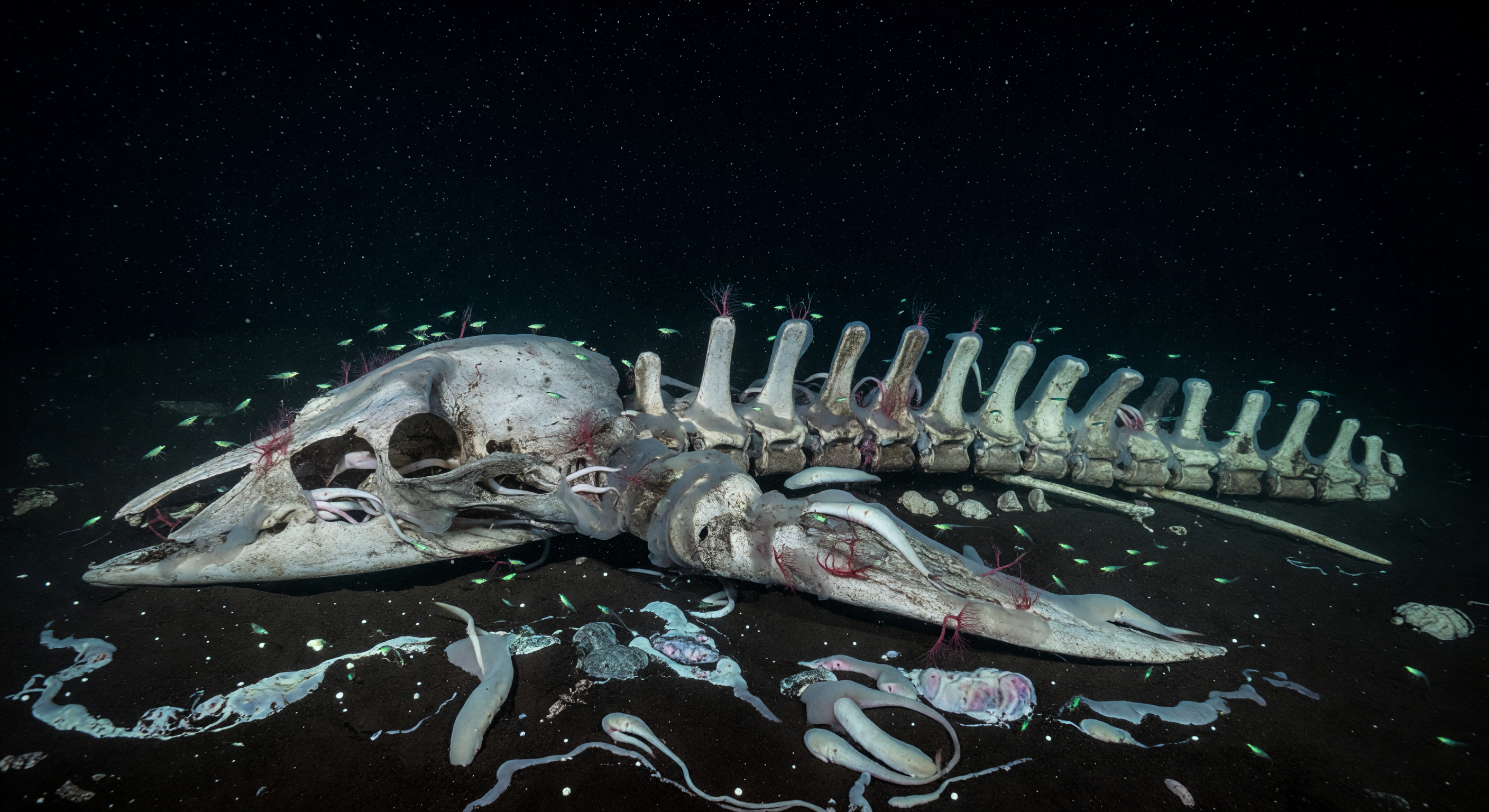
At depths where pressure exceeds two hundred atmospheres and no photon of sunlight has ever reached, a whale skull and its long chain of vertebrae rest half-buried in anoxic sediment, becoming an entire world unto themselves. The carcass has passed through the violent scavenger stage and now exists in its chemosynthetic afterlife — the bones themselves are the substrate, their lipid-saturated interiors exhaling hydrogen sulfide through slow anaerobic bacterial decomposition, sustaining a reducing microhabitat in the midst of an otherwise impoverished abyssal plain. Osedax worms, the so-called bone-eating snot-flowers, anchor their root-like tissues directly into the porous matrix of each vertebra, extracting collagen with the help of endosymbiotic bacteria, their crimson gill plumes rising in delicate fans from every available surface while hagfish coil through the orbital cavities of the skull in slow, muscular loops. The bacterial carpets draped across the ivory and ash-gray bone are not passive decay but active chemosynthetic communities, converting sulfide to biomass just as their cousins do at cold seeps thousands of kilometers away, and the emerald flickers tracing each ridge belong to small shrimp grazing these microbial films — brief cold sparks of bioluminescence in water that carries marine snow silently downward through absolute darkness. This is the long chemical afterlife of a giant, a decades-long cascade of ecological succession playing out in perfect silence, with no witness, in water so cold and still it preserves every filament of bacterial velvet exactly where chemistry placed it.
Other languages
- Français: Tapis Bactériens d'Os
- Español: Alfombras Bacterianas de Hueso
- Português: Tapetes Bacterianos de Osso
- Deutsch: Bakterielle Knochenteppiche
- العربية: سجاد بكتيري من العظام
- हिन्दी: हड्डी के जीवाणु कालीन
- 日本語: 骨の細菌カーペット
- 한국어: 뼈의 박테리아 카펫
- Italiano: Tappeti Batterici d'Ossa
- Nederlands: Bacteriële Tapijten van Bot