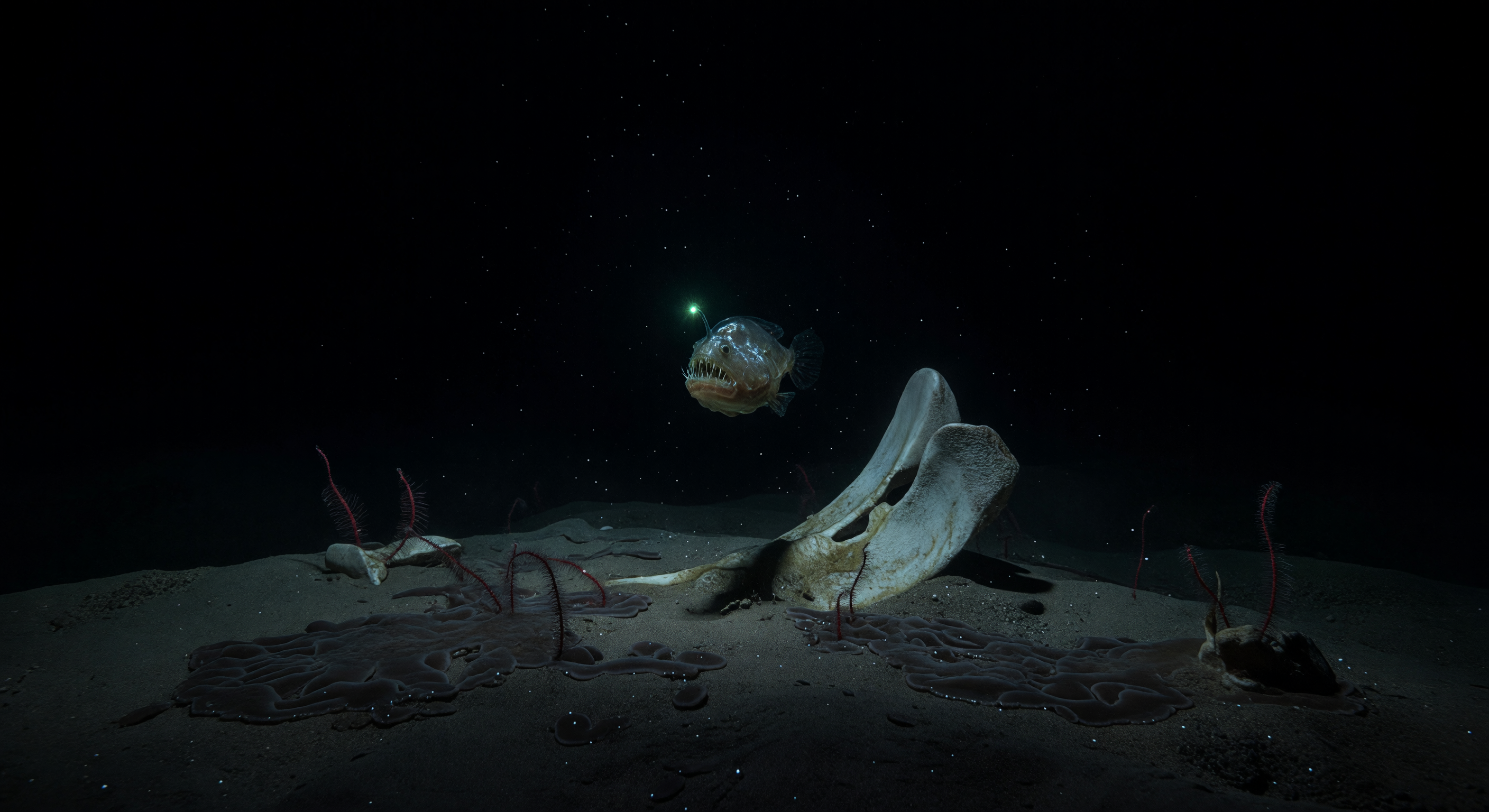
At roughly 2,500 metres below the surface, where pressure exceeds 250 atmospheres and no trace of solar light has ever penetrated, a detached whale vertebra rests half-buried in fine abyssal sediment — a remnant of what was once a colossal carcass, now reduced to bone and chemistry. The skeleton has become an island of energy on an otherwise barren plain, its porous mineral surfaces colonised by a pale bacterial film stained faintly with sulfide, while nearby sediment hosts dense bacterial mats feeding on the organic compounds still seeping from decomposing lipid-rich bone tissue — the sulfophilic stage of whale-fall succession described by Smith and Baco. A female ceratioid anglerfish hangs motionless in the black water column beside the vertebra, her swollen body perfectly neutrally buoyant, her single bioluminescent esca emitting a cold cyan-green glow produced by symbiotic bacteria housed within the lure — the only illumination in this scene, catching needle teeth and drifting particles of marine snow that fall at less than a metre per day from the world above. At the edge of visibility, crimson Osedax plumes extend from another bone fragment, these bone-eating worms boring into the matrix with root-like tissue that digests collagen and lipids through symbiotic bacteria, binding the whale-fall community into a chemosynthetic web that owes nothing to sunlight. This is a world complete and ancient in itself, operating in permanent darkness, immense stillness, and cold near-freezing water, indifferent to any gaze.
Other languages
- Français: Lotte près d'une vertèbre
- Español: Rape junto a una vértebra
- Português: Peixe-pescador junto à vértebra
- Deutsch: Anglerfisch neben Wirbel
- العربية: سمكة الصياد عند فقرة
- हिन्दी: कशेरुका के पास एंगलर
- 日本語: 脊椎骨のそばに釣り師
- 한국어: 척추뼈 옆의 아귀
- Italiano: Pescatrice accanto a vertebra
- Nederlands: Zeeduivel bij een wervel