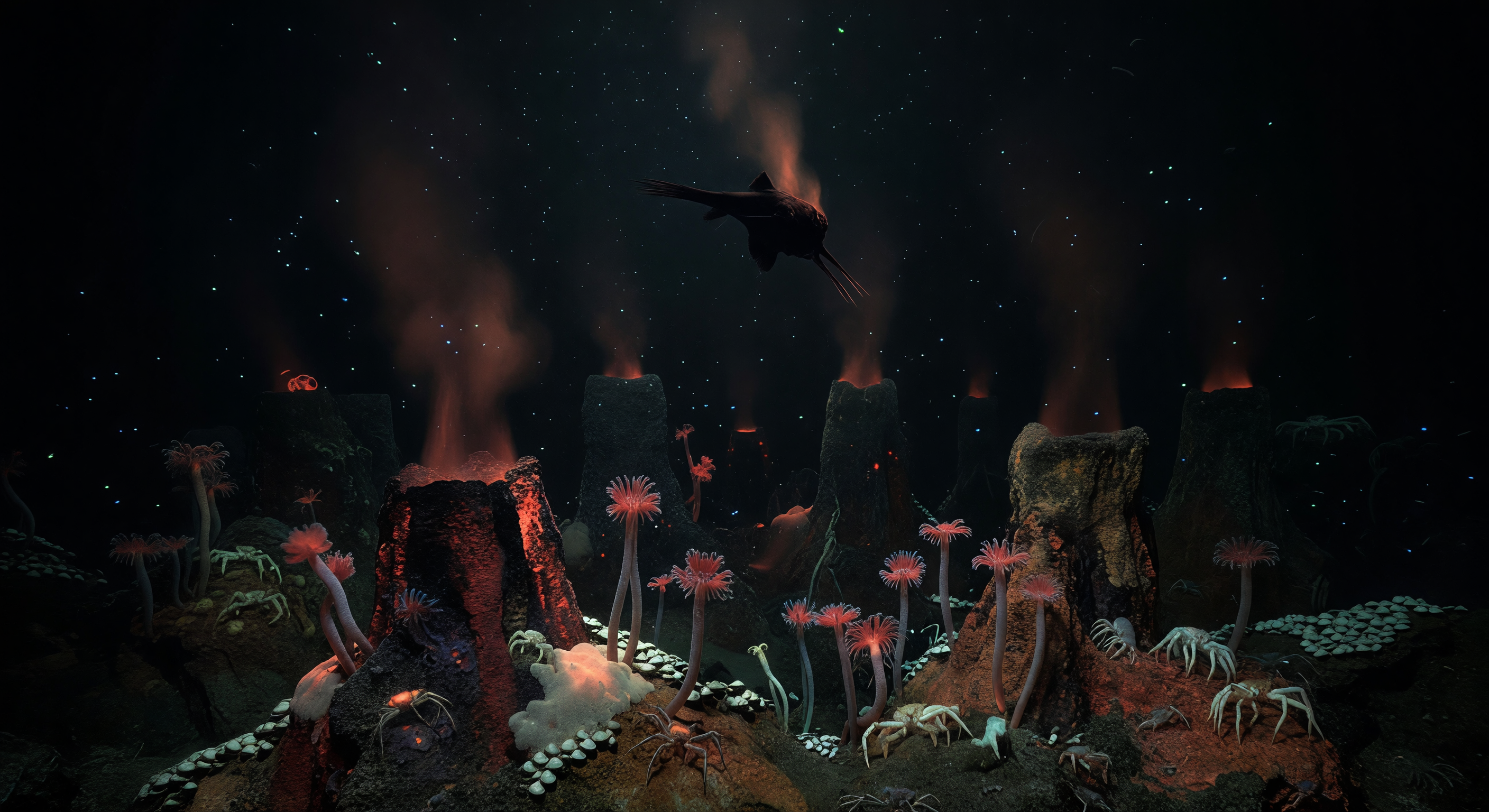
At roughly one to four kilometres below the surface, where pressure exceeds one hundred atmospheres and the last trace of solar light dissolved long ago, a viperfish hangs in the water column as a pure silhouette — its needle fangs and elongate body lit only by the diffuse orange-red chemiluminescent glow rising from the black-smoker field far beneath it. Down on the basalt seafloor, hydrothermal chimneys exhaust superheated fluid at temperatures approaching 350 °C, precipitating towering sulfide structures and wreathing the surrounding rock in mineral-laden plumes; the thermal gradient sustains dense chemosynthetic ecosystems — bacterial mats, Riftia pachyptila tubeworm colonies with their crimson plumes, carpets of Calyptogena clams, and pale yeti crabs pressing against warm sulfide ledges — all of them drawing energy from hydrogen sulfide rather than sunlight. Scattered through the open water above, cyan and blue-green bioluminescent pinpricks mark drifting organisms too small to name individually, their faint emissions the only illumination beyond the vent glow itself. Marine snow and fine mineral particles drift slowly downward, carrying the chemistry of the mid-water into this benthic world, while the viperfish — Chauliodus sloani or a close relative, a pursuit predator of the midnight zone — remains perfectly still for an instant, suspended between the black water above and the primordial heat below, belonging entirely to a world that has existed on these terms for millions of years.
Other languages
- Français: Vipérine sur les Fumeurs
- Español: Víborapez sobre Fumadores
- Português: Peixe-víbora sobre Fumegantes
- Deutsch: Fangzahnfisch über Schwarzen Rauchern
- العربية: سمكة الأفعى فوق المدخنات
- हिन्दी: धुआँ स्तंभों के ऊपर वाइपरफिश
- 日本語: 煙突の上のバイパーフィッシュ
- 한국어: 열수분출구 위의 살모사물고기
- Italiano: Pesce Vipera sui Fumatori
- Nederlands: Addervis boven Rookers