Where tectonic plates pull apart along a mid-ocean ridge, seawater percolates kilometers into fractured basalt, superheats against magma, and surges back as mineral-laden fluid at temperatures exceeding 350 °C — and from this violent chemistry, an entire ecosystem assembles itself in permanent darkness. Dense groves of *Riftia pachyptila* rise in pale ivory columns, some exceeding two meters, their vivid scarlet plumes — rich with hemoglobin adapted to carry both oxygen and hydrogen sulfide simultaneously — hovering in the milky shimmer of diffuse vent flow as it washes upward through cracked sulfide crust and jagged basalt. White bacterial mats blanket the warmest rock surfaces, fixing energy through chemosynthesis rather than sunlight, forming the photosynthesis-independent foundation of a food web that sustains clusters of *Calyptogena* clams wedged into seafloor pockets and pale yeti crabs (*Kiwa* sp.) braced at the scalding periphery of the colony, their long setae combing chemosynthetic bacteria directly from the superheated gradient. Black smoker chimneys exhale dense columns of precipitating minerals — anhydrite, pyrite, chalcopyrite — against water held at roughly 2 °C and 300 atmospheres of pressure, while the newest basalt seams carry the faintest thermoluminescent warmth along their fracture lines. Beyond the vent garden's haze of heat distortion and suspended mineral particles, the surrounding seafloor drops away into a darkness so absolute and so pressurized that it constitutes its own geological silence — a world that has sustained itself, without sunlight, for millions of years.
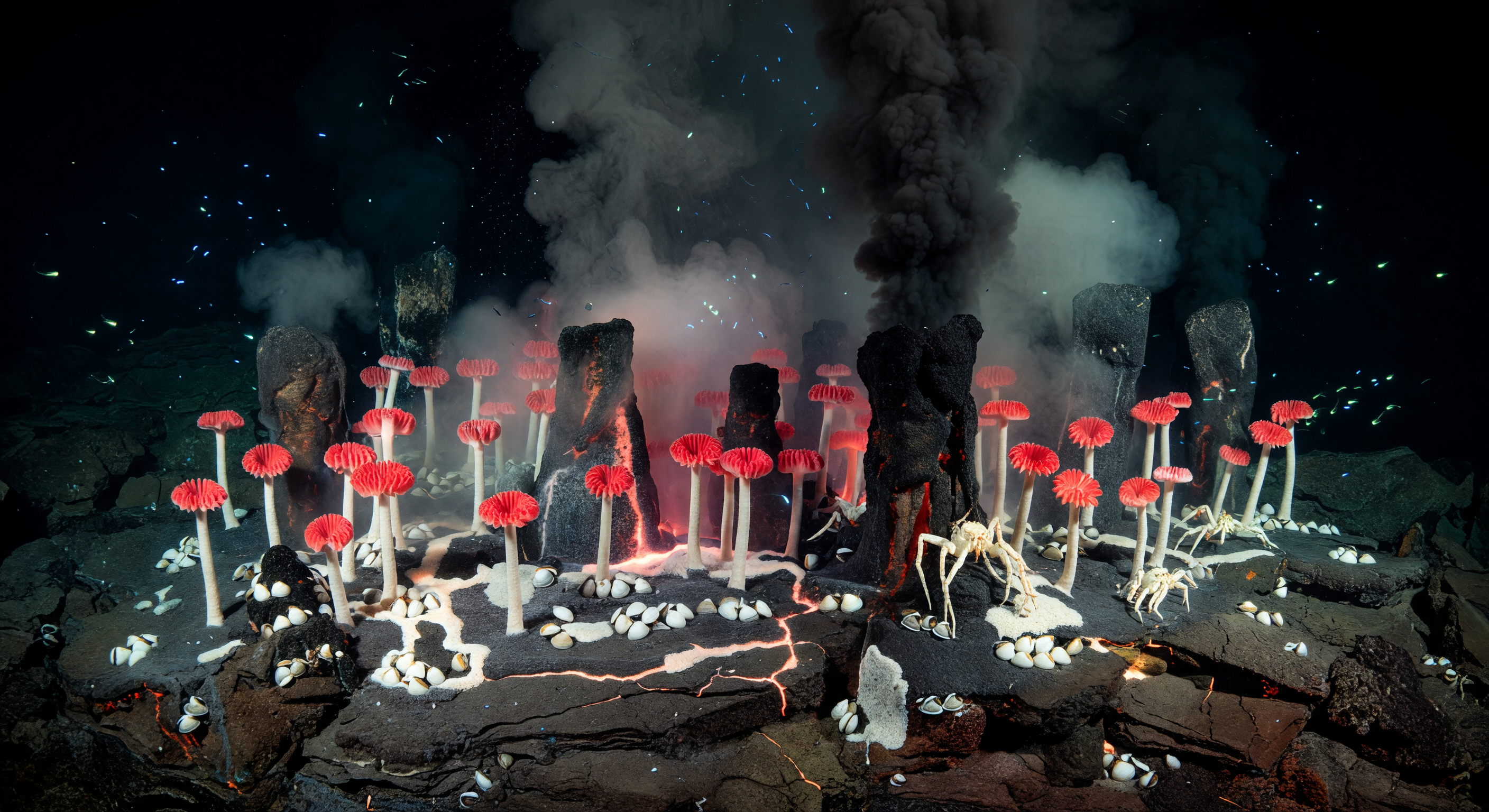
Hydrothermal vents