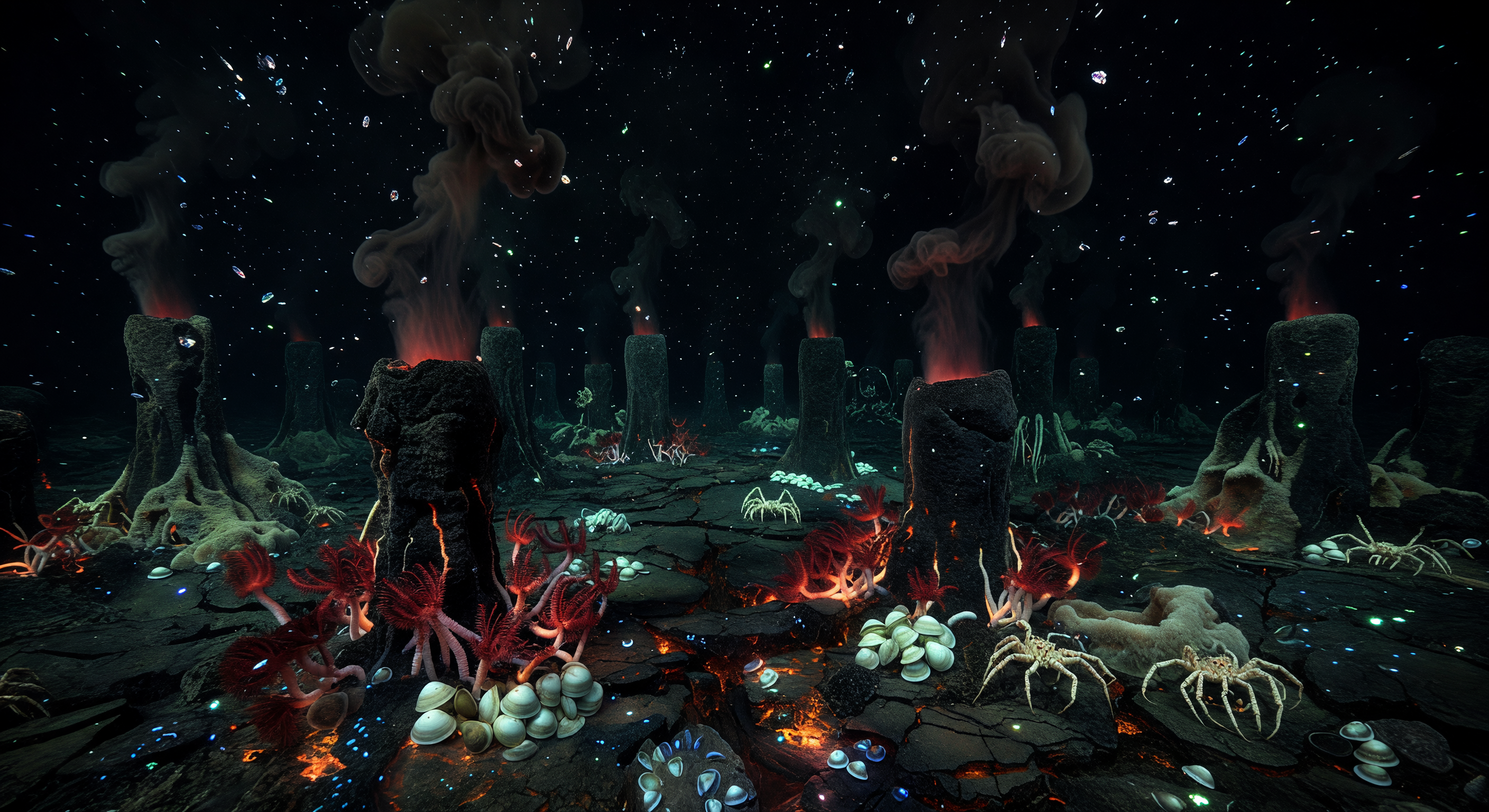
Where the mid-ocean ridge fractures open along fresh basalt, superheated fluid — laden with dissolved metals, sulfides, and silicates — erupts upward through towering chimney structures at temperatures exceeding 400 °C, billowing into ambient seawater barely above freezing and precipitating an incessant mineral snow: sulfide crystals, anhydrite flakes, and bacterial aggregates that drift slowly downward through absolute darkness, caught only by the faint chemiluminescent ember-glow radiating from within the plumes themselves. At pressures between 200 and 400 atmospheres, no sunlight has penetrated this water for millennia, yet the ecosystem here is extravagantly alive — dense stands of *Riftia pachyptila* tube worms extend crimson gill plumes into the shimmering, heat-distorted water column, their tissues nourished not by photosynthesis but by endosymbiotic chemoautotrophic bacteria that oxidize hydrogen sulfide as an energy source. Ghost-white *Calyptogena* clams crowd the warm cracks in the basalt, and pale yeti crabs — their chelipeds thickly colonized by filamentous bacteria — press against sulfide ledges glazed with microbial mat, harvesting the chemical gradient between the scalding effluent and the surrounding abyss. Scattered cold points of cyan and blue-green bioluminescence pulse among the fauna and the rising particulate, the only light that belongs entirely to life itself — a primordial economy of chemistry and darkness, cycling sulfur and carbon through a community that has no need of the sun, and no knowledge of the surface world far above.
Other languages
- Français: Neige Minérale sur Cheminées
- Español: Nieve Mineral sobre Chimeneas
- Português: Neve Mineral sobre Chaminés
- Deutsch: Mineralschnee über Schloten
- العربية: ثلج معدني فوق المداخن
- हिन्दी: चिमनियों पर खनिज हिमपात
- 日本語: 煙突を覆う鉱物の雪
- 한국어: 굴뚝 위 광물 눈
- Italiano: Neve Minerale sui Camini
- Nederlands: Mineraalsneeuw boven Schoorstenen