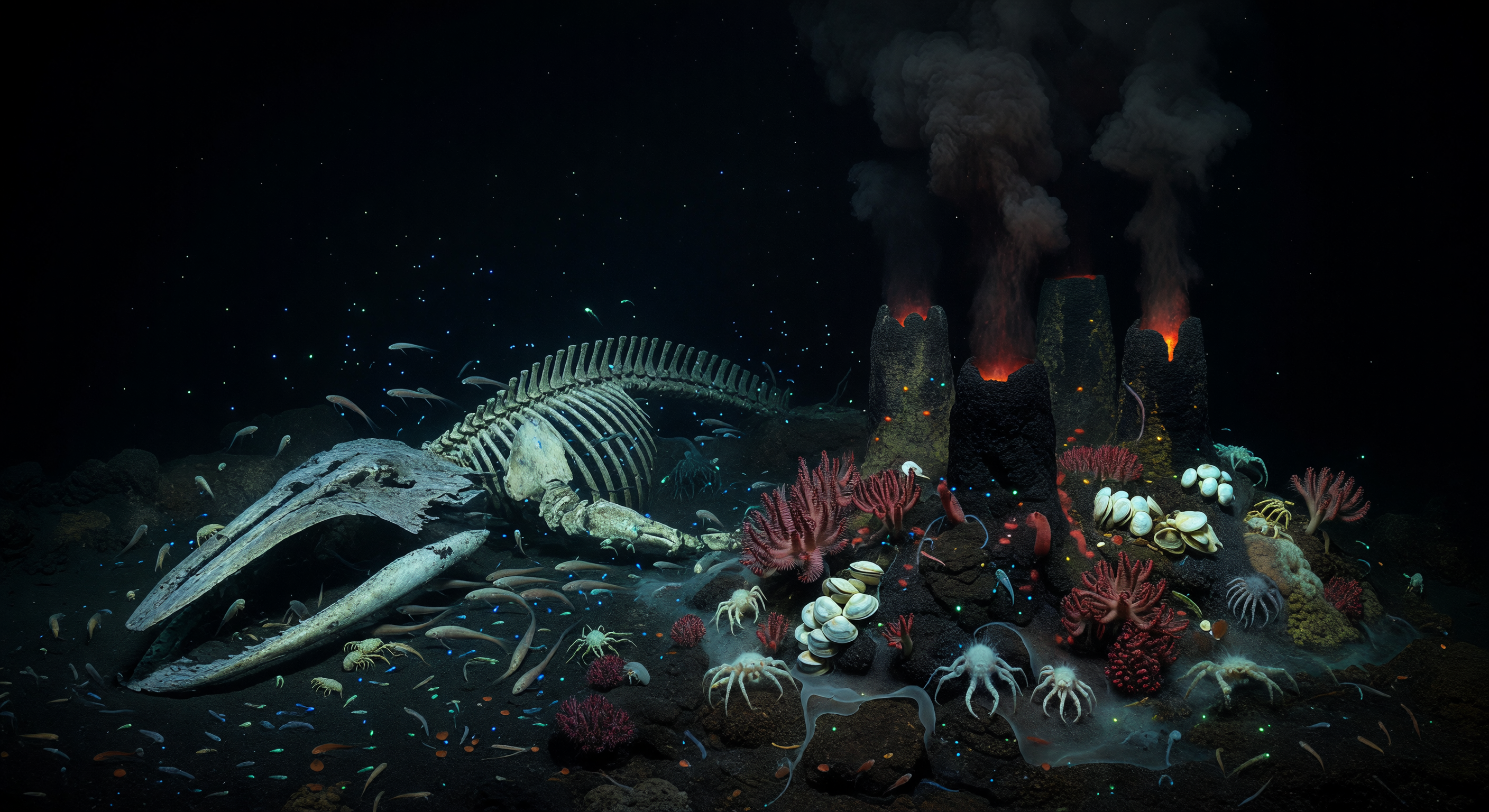
Where tectonic plates pull apart along a mid-ocean ridge, superheated fluid charged with hydrogen sulfide, methane, and dissolved metals erupts through fractured basalt at temperatures approaching 350 °C, building towering sulfide chimneys whose billowing plumes carry a faint ember-glow of chemiluminescence into water held near freezing by pressures exceeding 200 atmospheres. Beside one such outcrop, the skeleton of a great whale has come to rest on the abyssal sediment, its bleached and mineral-stained ribs half-buried in black mud, transformed now into an ecosystem of its own — a whale fall in its sulphophilic stage, where the lipid-rich bones sustain dense chemosynthetic microbial mats that in turn feed hagfish coiling through the vertebral arches, amphipods flickering in pale constellations across the skull, and squat lobsters whose blue-green bioluminescence traces each rib like a living diagram. At the vent base, colonies of *Riftia pachyptila* tube worms extend their scarlet plumes into the sulfide-laden gradient, flanked by white vesicomyid clams and pale Yeti crabs combing bacterial films from the chimney flanks — all organisms whose metabolisms are coupled not to sunlight but to the chemical energy bleeding from the planet's interior. Fine mineral particles and marine snow drift through absolute darkness beyond these intimate pools of cold light, and the scene unfolds without witness, existing entirely within itself, a convergence of geological heat and biological patience at a depth where the ocean has never required an audience.
Hydrothermal vents