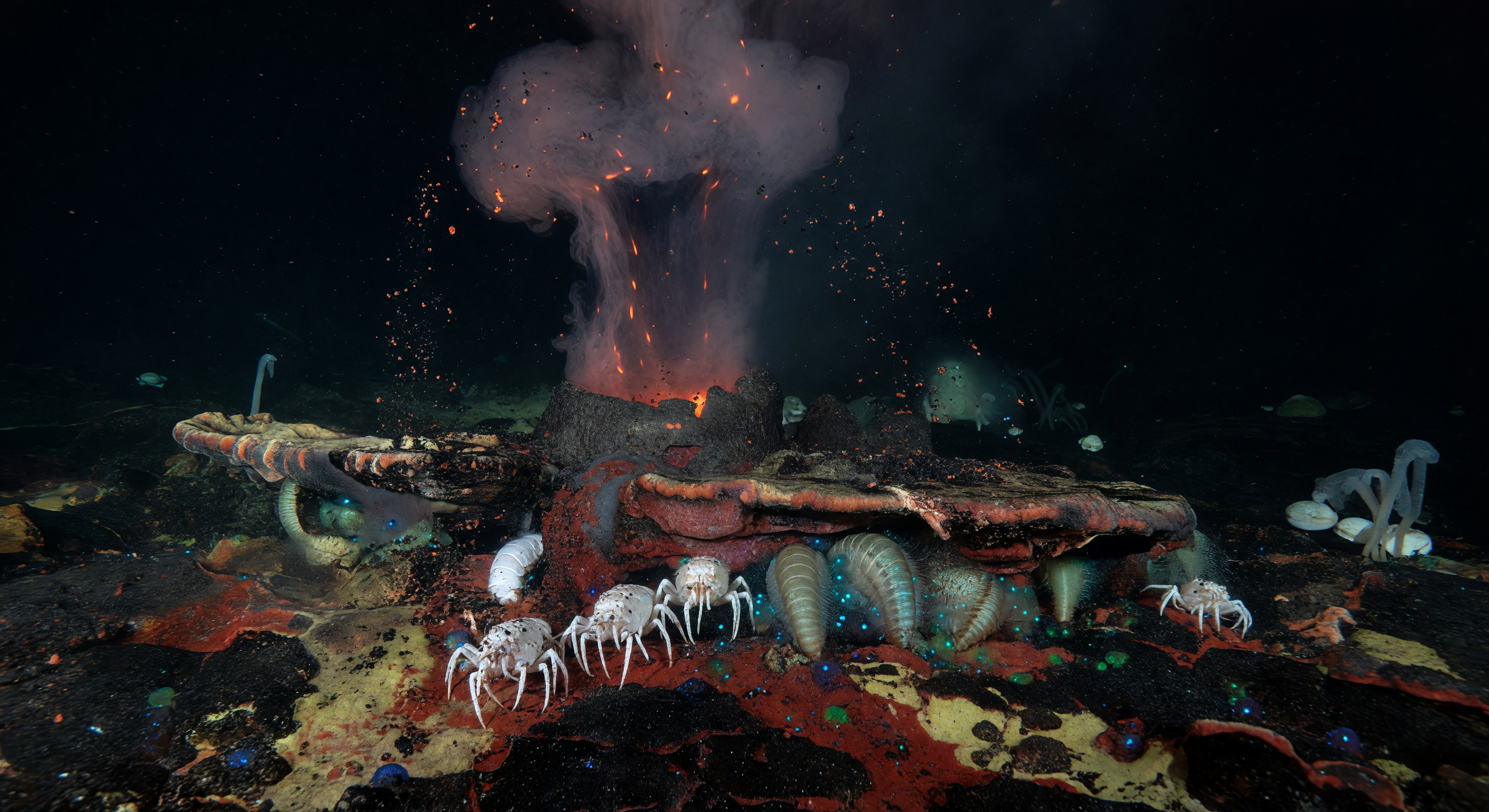
At roughly 2,500 metres below the surface, where pressure exceeds 250 atmospheres and no solar photon has ever penetrated, a black smoker chimney exhales superheated fluid at 350 °C into near-freezing ambient water, precipitating a continuous fall of metallic sulfide grains — iron pyrite, chalcopyrite, anhydrite — that drift like volcanic ash over a narrow ledge of fresh basalt. Squat lobsters of the genus *Munida* or *Pleuroncodes* cluster along the mineral-crusted rock, their pale carapaces dusted with fresh precipitate, feeding opportunistically on microbial mats and organic particles carried by the plume's convective upwelling, while broad-bodied scale worms press flat against the sulfide surface, their iridescent paleae catching the only available light — a faint ember-orange chemiluminescence generated within the hottest vent effluent by thermochemical reactions, and dim cyan-green bioluminescent pulses from microbial communities colonising the chimney walls. Beyond the plume's thermal halo, the water reverts to its true nature: black, cold, utterly silent, threaded only by the slow vertical drift of marine snow descending from a sunlit world thousands of metres above. Here the entire food web inverts the logic of the biosphere, drawing energy not from the sun but from the oxidation of hydrogen sulfide by chemolithoautotrophic bacteria, sustaining an ecosystem of ghostly white clams, vestimentiferan tube worms, and crustaceans that have never needed light to thrive — a sealed volcanic economy operating in complete indifference to the illuminated ocean above.
Other languages
- Français: Crustacés sous la cendre
- Español: Crustáceos en ceniza oscura
- Português: Crustáceos na cinza negra
- Deutsch: Krebstiere im fallenden Asche
- العربية: قشريات تحت الرماد
- हिन्दी: राख में क्रस्टेशियन
- 日本語: 降り注ぐ灰の甲殻類
- 한국어: 재 속의 갑각류
- Italiano: Crostacei nella cenere
- Nederlands: Schaaldieren in vallende as