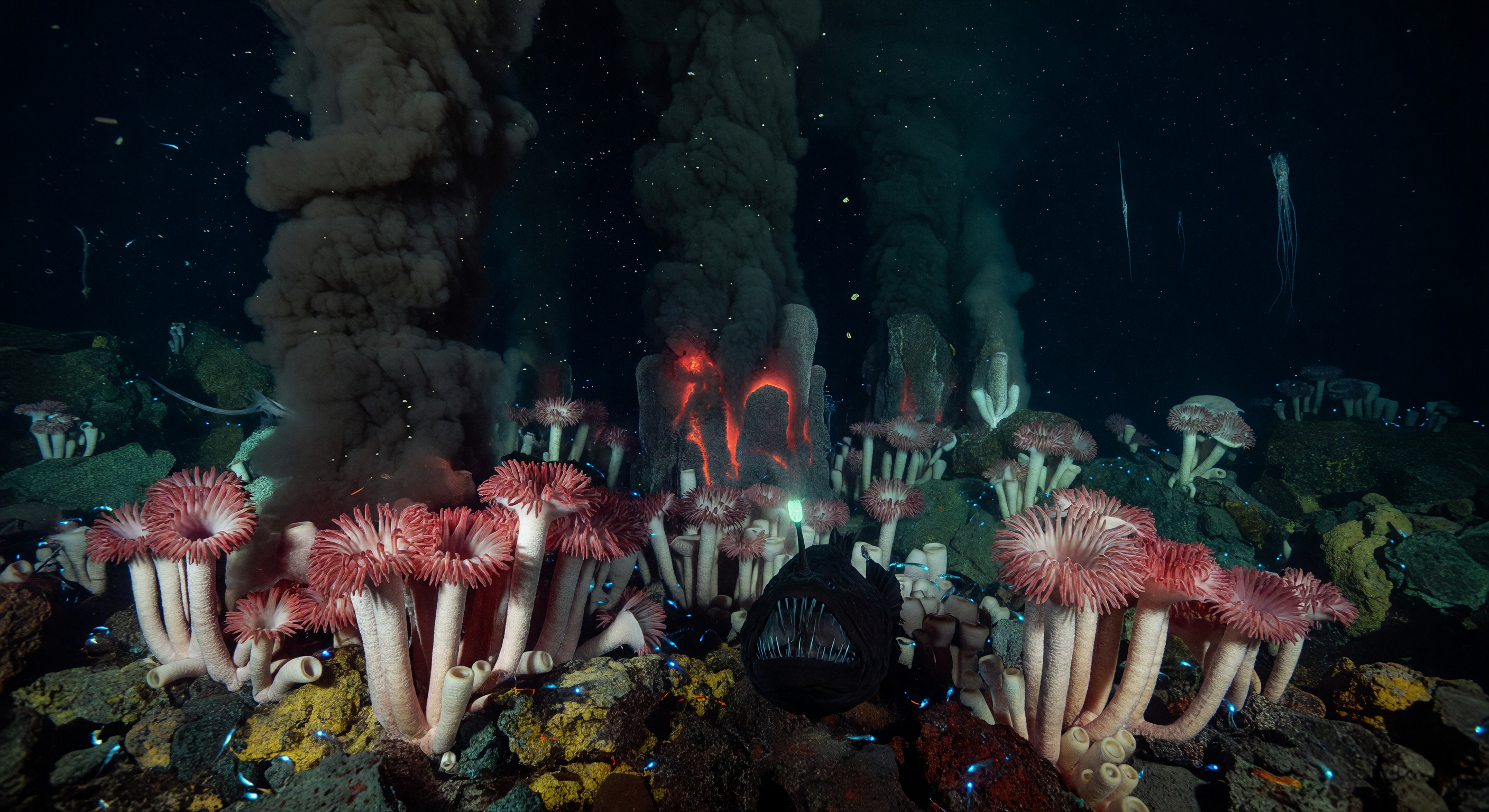
At the fractured margin of a hydrothermal vent field somewhere between one and four kilometers beneath the surface, dense forests of giant tube worms — Riftia pachyptila and their relatives — rise from sulfide-encrusted basalt in tightly packed colonies, their ivory tubes topped with soft crimson plumes that sway in the slow convective currents rising from below, sustained not by sunlight but by the chemosynthetic metabolism of bacterial endosymbionts converting hydrogen sulfide into organic carbon. Black smoker plumes billow upward in layered mineral folds, and the restrained orange-red thermal glow seeping from fresh basalt seams, combined with the faint chemiluminescent haze of oxidizing mineral particulates, defines the only ambient light in water where photosynthetically active radiation has been functionally absent for hundreds of meters above. Along the crowded perimeter of the colony, small bioluminescent invertebrates pulse cyan and blue against wet chitin and sulfide-stained rock, and it is precisely here, at the lit edge of this chemosynthetic oasis, that an abyssal anglerfish holds itself motionless — its pressure-adapted body matte and dense, oversized jaws lined with translucent recurved teeth, its esca glowing cold greenish-cyan in a slow rhythmic pulse that mimics the very bioluminescence surrounding it, a lure evolved over millions of years to exploit the visual reflexes of prey that have no other light to follow. Beyond it, the vent field recedes into towering chimneys and smoky mineral veils, and somewhere deeper in the black water the needle silhouette of a viperfish and the improbable trailing filaments of a Magnapinna squid persist as barely resolved forms — pressure-tolerant bodies carrying the full evolutionary weight of an ecosystem that has never needed the sun.
Bathypelagic predators