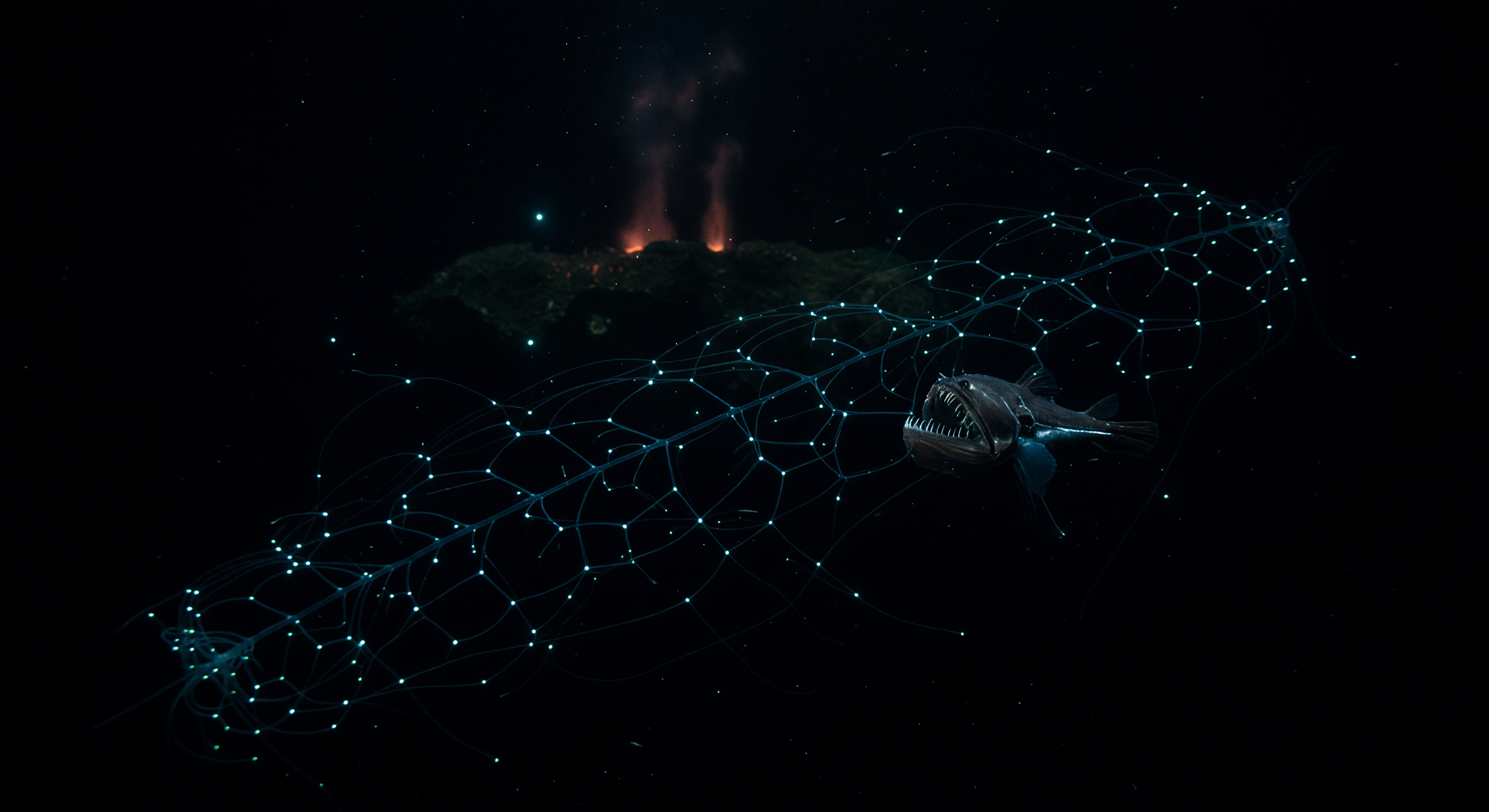
In the permanent darkness between one and four kilometers down, where pressure exceeds two hundred atmospheres and cold seawater hovers near two degrees Celsius, a siphonophore — not a single animal but a superorganism of coordinated zooids — suspends itself across the open water column like a living constellation, each nectophore and dactylozooid emitting soft blue-green photophores that collectively form a luminous geometric lattice, a passive trap evolved over millions of years to lure and snare whatever drifts within reach. Chauliodus sloani, the viperfish, positions itself just beyond this bioluminescent architecture in near-perfect ambush stillness, its elongated body barely distinguishable from the surrounding blackness, its needle-like fang teeth — proportionally the largest of any fish relative to head size — catching only intermittent cold cyan sparks from nearby zooplankton flashes and the siphonophore's own glow. Marine snow descends continuously through the water column in this zone, mineral particles and organic aggregates drifting like slow debris through a world where there is no sunlight, no season, and no surface rhythm, only the sporadic logic of bioluminescent deception and sudden predation. Far below in the background, a hydrothermal vent province exhales a faint chemiluminescent haze above fresh basalt, its reduced sulfur compounds supporting chemosynthetic communities entirely independent of photosynthesis, a reminder that energy in the deep ocean flows through pathways the sunlit world knows nothing of. This is a cold, pressurized, ancient darkness that functions with complete indifference to observation — a predator and its trap suspended in black water, waiting in a silence that has no need of witnesses.
Bathypelagic predators