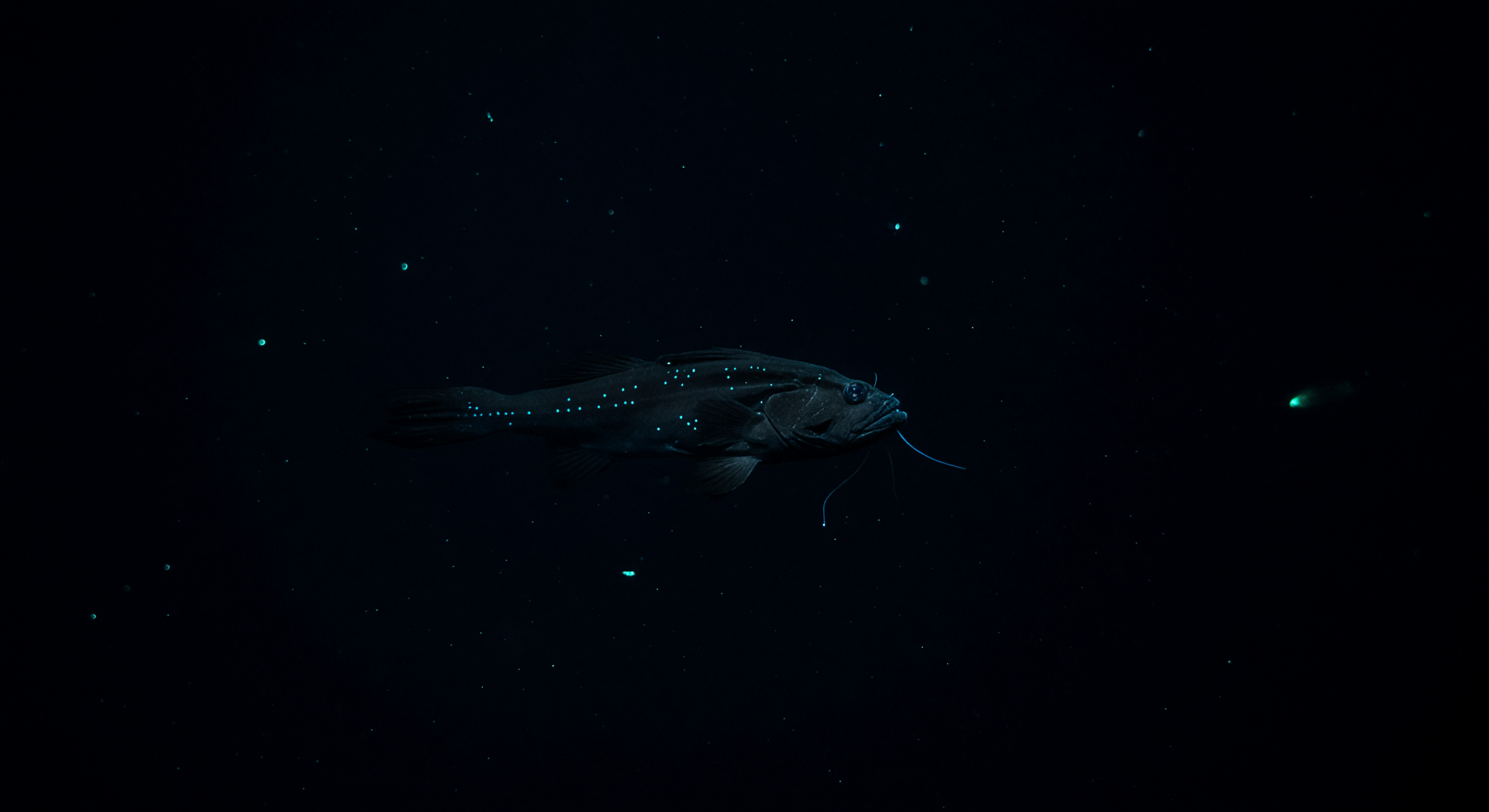
In the absolute darkness between one and four kilometers below the surface, where pressure exceeds two hundred atmospheres and sunlight has been extinct for hundreds of meters above, a black dragonfish — most likely a species of *Idiacanthus* or a relative within the family Stomiidae — hangs motionless in open midwater, its elongate body so deeply melanized that it absorbs nearly all bioluminescent photons that strike it, rendering it a near-perfect void within a void. Along its flank, rows of cyan photophores — intrinsic light organs derived from modified scales and underlying chromatophores — emit a species-specific signal pattern, a private wavelength tuned to conspecific eyes and largely invisible to prey with narrower spectral sensitivity; the slender chin barbel, trailing below the jaw like a filament of living glass, serves simultaneously as a lure and a sensory probe in water that carries no current strong enough to disturb it. Marine snow — the constant slow precipitation of organic detritus, fecal pellets, and bacterial aggregates that constitutes the primary energy transfer from the sunlit surface to these depths — drifts through the faint bioluminescent glow in all directions, each particle a slow-falling reminder that this darkness is not empty but metabolically connected to the world above. The surrounding water column holds no floor and no ceiling within any perceptible distance, only an expanding volume of cold, clear, pressurized ocean where every organism that passes must carry its own light or live entirely without it — a world of intermittent, purposeful glimmers suspended in geological silence, existing on its own terms across timescales that have nothing to do with human witness.
Other languages
- Français: Signal Secret du Dragonfish
- Español: Señal Privada del Dragón
- Português: Sinal Secreto do Peixe-Dragão
- Deutsch: Drachenfisch Geheimes Signal
- العربية: إشارة سمكة التنين الخفية
- हिन्दी: ड्रैगनफिश का गुप्त संकेत
- 日本語: 竜魚の秘密信号
- 한국어: 드래곤피시의 은밀한 신호
- Italiano: Segnale Segreto del Dragopesci
- Nederlands: Drakenvis Geheim Signaal