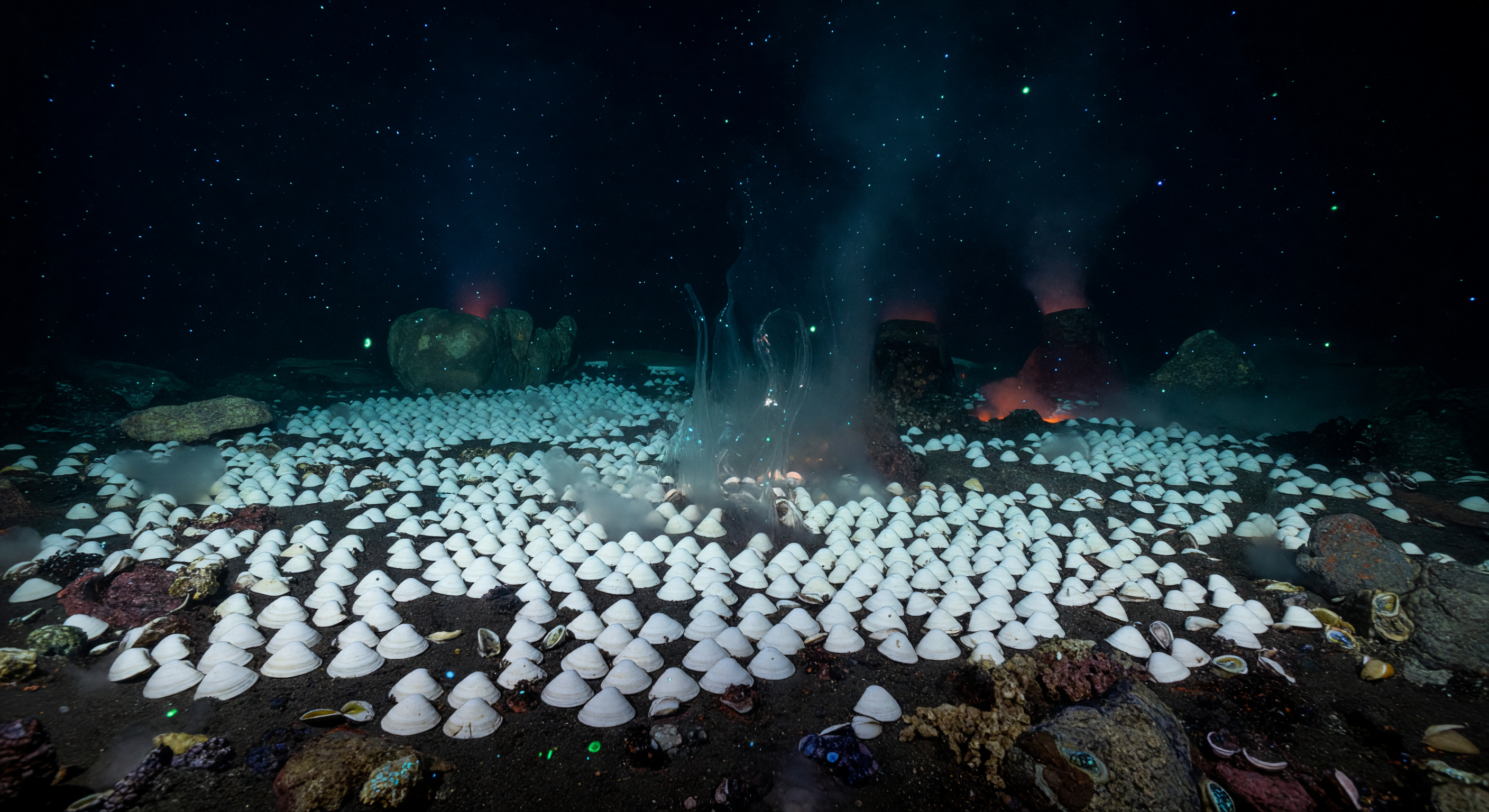
Where sunlight has never reached and pressure exceeds three hundred atmospheres, a vast shallow depression in the volcanic seafloor lies carpeted wall to wall with thousands of white clams — Calyptogena and their kin — their chalky shells packed so densely they form a living mosaic across dark basalt and sulfide crust. These bivalves owe nothing to photosynthesis; endosymbiotic bacteria housed within their gill tissue harvest hydrogen sulfide seeping upward through the sediment, converting chemical energy directly into organic matter in a process of chemosynthesis that has sustained vent communities since long before complex animal life diversified. Above the clam bed, mineral-rich fluid rises in wavering, refractive curtains, distorting the water column in slow shimmering veils and carrying faint milky hazes of microbial film and precipitating minerals at the point where superheated chemistry meets cold abyssal seawater. Sparse bioluminescent particles drift freely through the black-blue water — brief sparks of cyan and green tracing invisible currents — while marine snow settles in imperceptible suspension all around, and a dim chemiluminescent warmth bleeds upward from the vented ground itself. In the far distance, the silhouettes of black smoker chimneys rise against impenetrable darkness, their plumes dissolving silently into a world that needs nothing from above to persist, reproduce, and thrive.
Hydrothermal vents