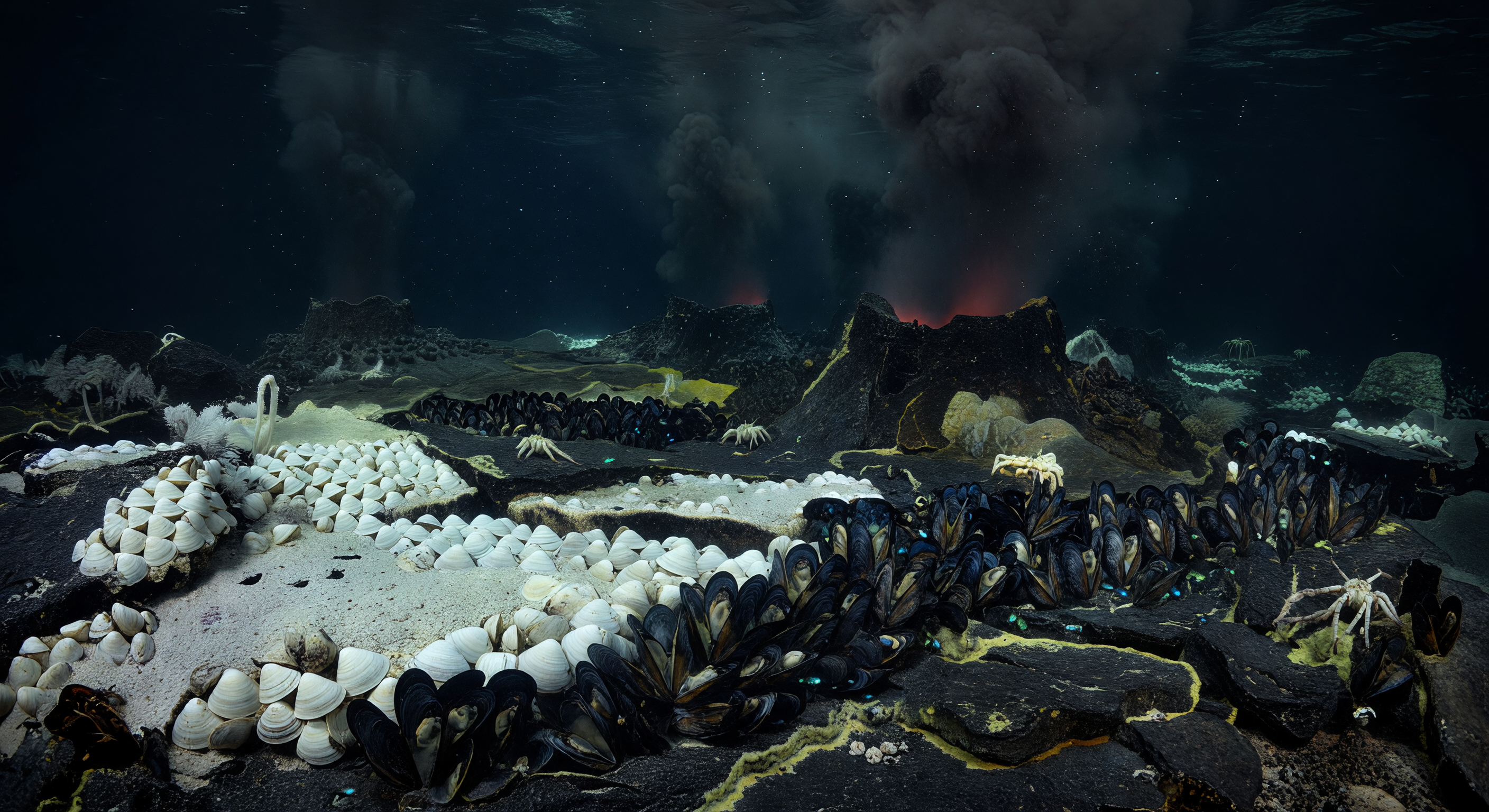
Along a fractured terrace of fresh black basalt on the mid-ocean ridge, the boundary between life strategies is written in shell and mineral: broad beds of white clams occupy the cooler sediment margins where chemosynthetic bacteria thrive within their tissues, while dense mussel aggregations pack tightly along the thermal gradient closer to active fissures, their dark satin shells overlapping in layered ranks. Above the seafloor, refractive shimmer betrays the mixing of superheated, mineral-laden fluid with near-freezing abyssal water, a boundary where hydrogen sulfide and methane fuel the entire food web through chemosynthesis rather than any trace of sunlight — which has not reached this depth, somewhere between one and four kilometers down, for as long as this ridge has been splitting apart. Tall black smoker chimneys exhale billowing plumes of three-hundred-and-fifty-degree fluid laden with iron, zinc, and copper sulfides, their charcoal columns dissolving into the immense cold darkness above, while a faint orange-red chemiluminescent glow pulses within the hottest effluent and a ghostly sheen drifts across pale microbial mats coating the surrounding crust. A yeti crab, its feathery setae dense with chemosynthetic bacteria, sits motionless among the mussels, farming its own food at a pressure exceeding two hundred atmospheres, while tiny cyan pinpricks of bioluminescence trace the path of small scavengers moving along the clam-to-mussel transition. Beyond the vent field, the water collapses into pure black — a primordial silence that has never required a witness.
Other languages
- Français: Frontière Palourdes et Moules
- Español: Frontera de Almejas y Mejillones
- Português: Fronteira de Mariscos e Mexilhões
- Deutsch: Muscheln an der Grenze
- العربية: حدود المحار والبلح
- हिन्दी: शंख और सीप सीमा
- 日本語: 貝とムール貝の境界
- 한국어: 조개와 홍합의 경계
- Italiano: Frontiera di Vongole e Cozze
- Nederlands: Grens van Mosselen en Kokkels