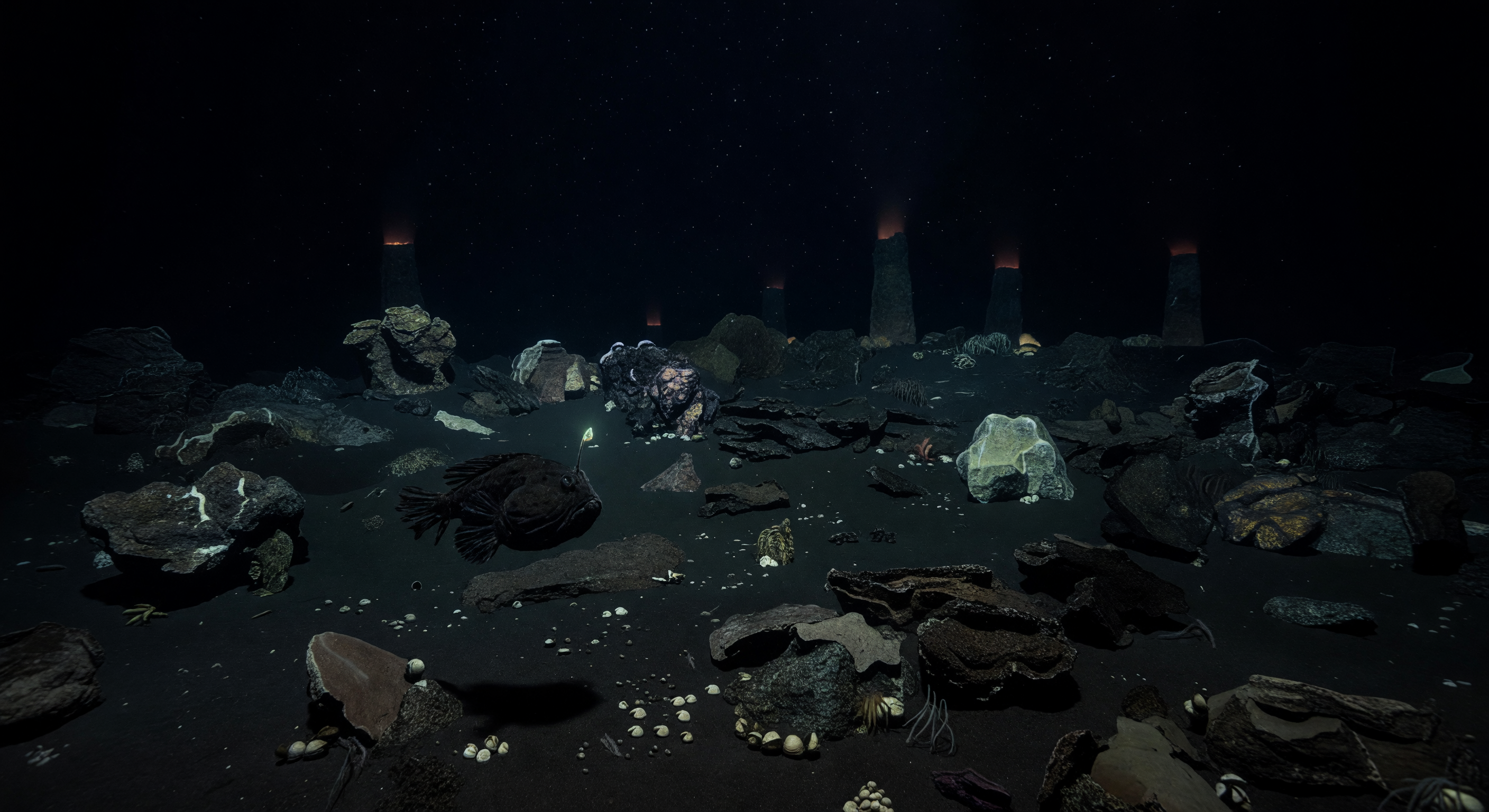
Beyond the main ventfield, where the last traces of chemosynthetic warmth fade into basaltic cold, a single anglerfish hangs suspended in the crushing stillness of water pressing down at hundreds of atmospheres — her pale cyan-green esca the only unambiguous light in this world, pulsing with bioluminescent bacteria cultivated within a modified dorsal spine through millions of years of deep evolution. That luminous lure, drifting perhaps two kilometers below the surface where photons from the sun are an irrelevance, faintly catches the wet charcoal of her skin, the glassy indifference of her eye, and the translucent edges of fins adapted to a life of near-perfect motionlessness amid sparse, drifting marine snow. Far beyond her, several black smoker chimneys rise as dark silhouettes against their own faint orange-red chemiluminescent shimmer, superheated plumes at 350 °C precipitating metal sulfides the moment they meet near-freezing ambient seawater, building the towering mineral structures that anchor dense communities of Riftia tube worms, chemosynthetic clams, and yeti crabs — ecosystems sustained entirely by the oxidation of hydrogen sulfide rather than sunlight. Between anglerfish and ventfield, scattered sulfide mounds and ash-dark sediment stretch across fresh pillow basalt on a mid-ocean ridge axis, a volcanic landscape that continuously reshapes itself along the planet's spreading boundaries, indifferent to any witness and luminous only on its own chemical terms.
Other languages
- Français: Pêcheur au-delà des évents
- Español: Anguilero más allá de las fumarolas
- Português: Pescador além das fontes
- Deutsch: Angler jenseits der Schlote
- العربية: مضيء خلف فوهات القاع
- हिन्दी: वेंट क्षेत्र से परे मछुआरा
- 日本語: 噴出孔の彼方の釣り人
- 한국어: 열수구 너머의 아귀
- Italiano: Pescatore oltre le bocche
- Nederlands: Hengelaar voorbij de ventopeningen