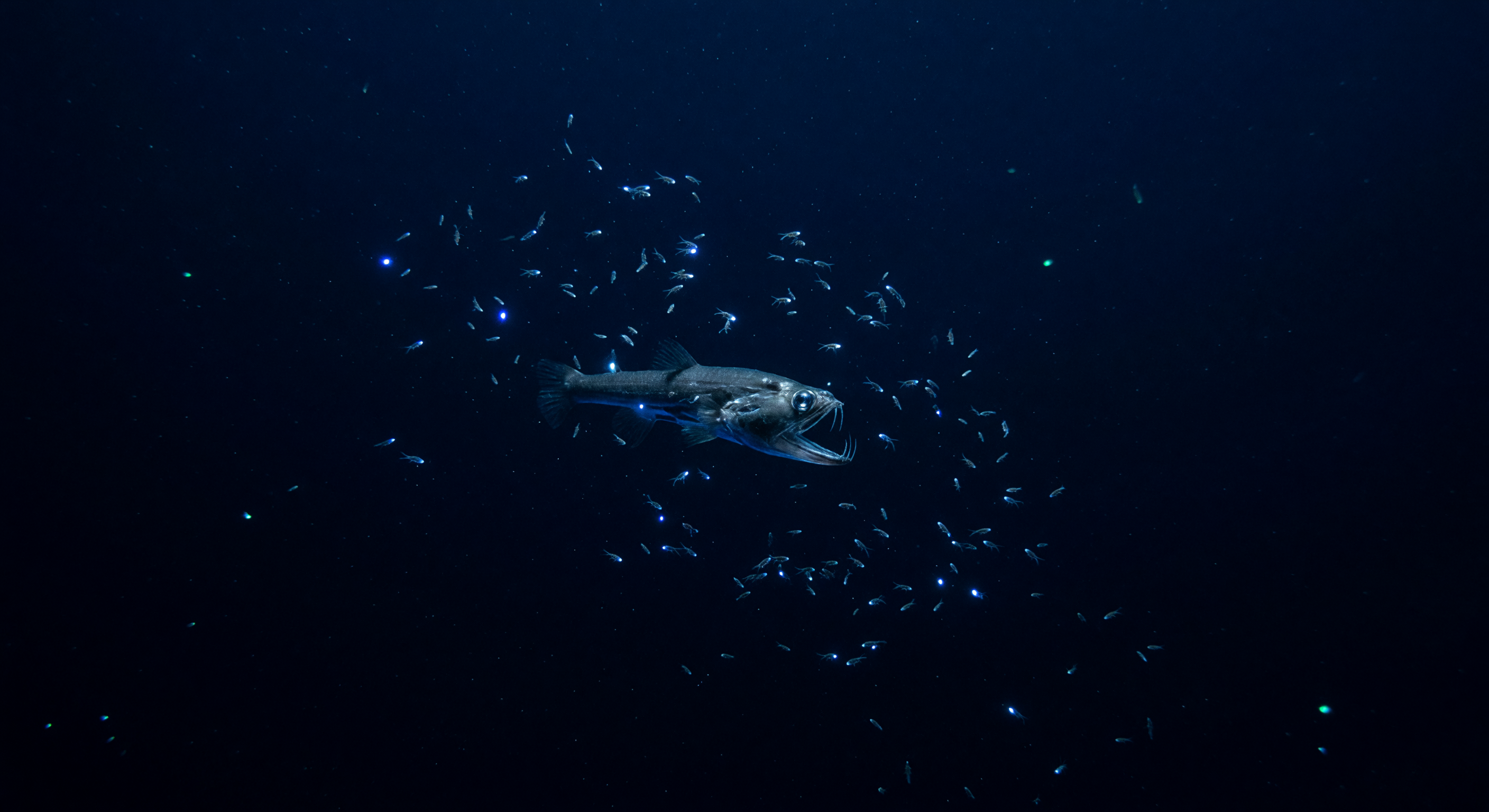
Between 1,500 and 2,500 meters, no photon from the sun has ever reached, and the water pressing inward from all directions exceeds 200 atmospheres — a crushing stillness in which warm-blooded intuitions about the ocean dissolve entirely. Here, Chauliodus sloani, the viperfish, is one of the midnight zone's most ruthless ambush predators: its elongated dorsal ray carries a bioluminescent tip used as a lure, while the lower fangs, too long to retract, lock upward like paired daggers when the jaws hinge open at extraordinary gape angles, allowing it to engulf prey approaching its own body length. The intermittent cyan-blue pulses threading through the disturbed cloud of deep pelagic crustaceans — likely euphausiids and hyperiid amphipods — are not coincidental decoration; they are alarm bioluminescence, a last chemical scream propagating outward through the swarm as bodies collide and scatter in three-dimensional panic, each flash briefly silhouetting the viperfish's gunmetal flanks and reflective tapetal eyes before the darkness reseals itself. Fine marine snow drifts indifferently through the entire corridor, organic particulate descending from the productive layers far above, the slow rain of carbon that feeds this entire dark ecosystem and connects the sunlit surface to a world that requires no light to function. The silence here is not empty — it is structured, pressurized, and teeming with predation invisible to every wavelength but its own.
Other languages
- Français: Couloir d'attaque du poisson vipère
- Español: Corredor del pez víbora
- Português: Corredor de ataque da víbora
- Deutsch: Vipernfisch Angriffskorridor
- العربية: ممر هجوم سمكة الأفعى
- हिन्दी: वाइपरफिश हमला गलियारा
- 日本語: バイパーフィッシュの回廊
- 한국어: 살무사고기 공격 통로
- Italiano: Corridoio d'attacco del pesce vipera
- Nederlands: Addervis aanvalscorridor