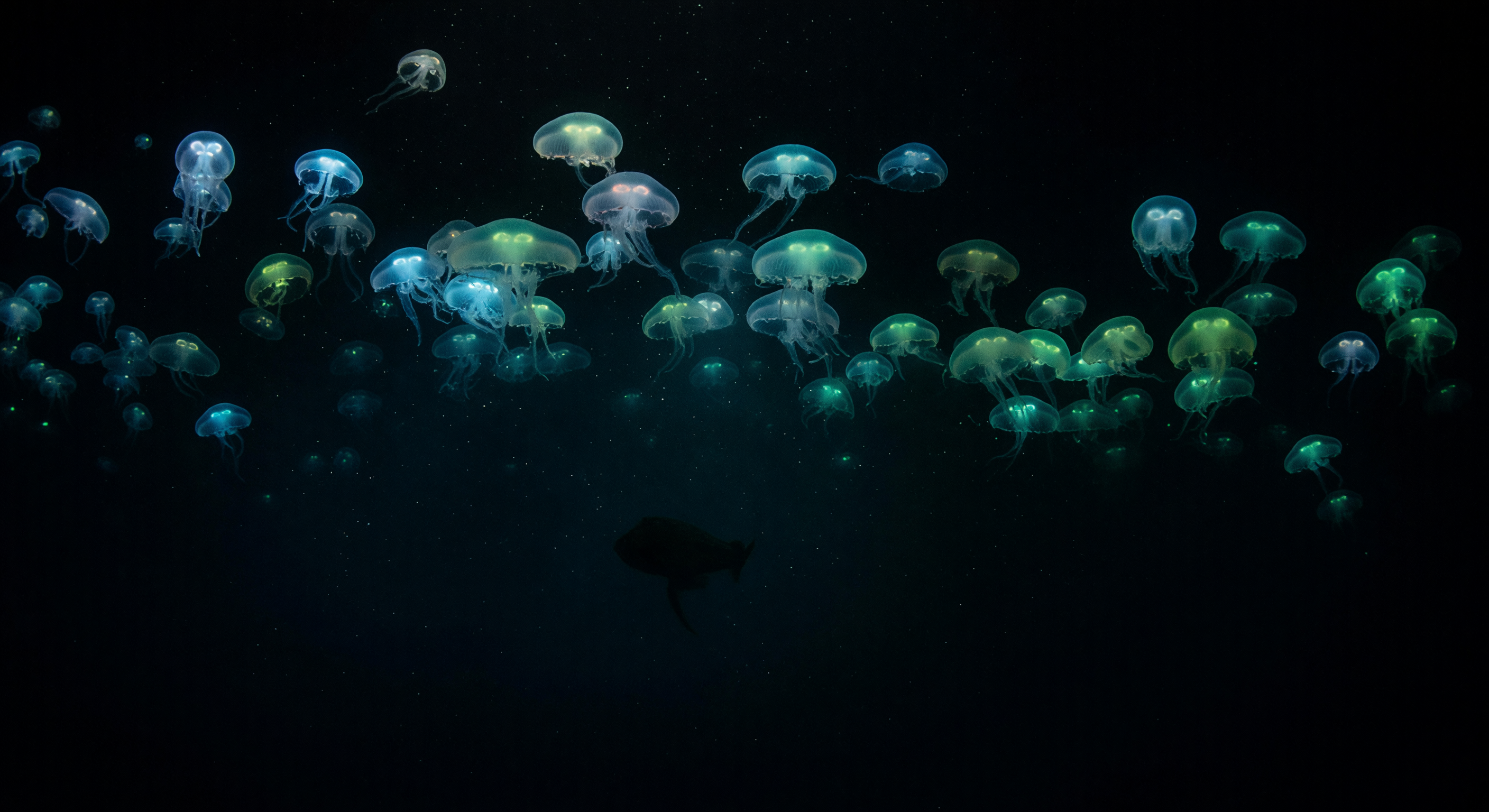
Between one thousand and four thousand meters below the surface, the midnight zone is a world of absolute cold, crushing pressure, and self-generated light. Here, where hydrostatic force reaches two hundred atmospheres or more, colonies of gelatinous medusae drift through vast black water in layered formation, their translucent bells and radial canals firing successive pulses of cold cyan and blue-green bioluminescence — a living canopy assembled not by any coordinated behavior but by the same dark currents that carry marine snow through the void in every direction. Each medusa is a pressure-adapted architecture of near-transparent mesoglea and delicate oral arms, tissue so gossamer it seems impossible under such compression, yet biochemically tuned to function perfectly in the cold and dark. Beneath this flickering ceiling of biological light, a deeper silhouette moves without illumination — a bathypelagic predator, perhaps a dragonfish or a large cephalopod, using the darkness itself as cover while scanning the luminous canopy above for the behavioral signatures of prey. This is the ocean as it has always been: layered, patient, and radically self-sufficient, its only light produced by the animals themselves, its only sound the faint hydrodynamic pressure of bodies passing through water that has never known the sun.
Bathypelagic predators