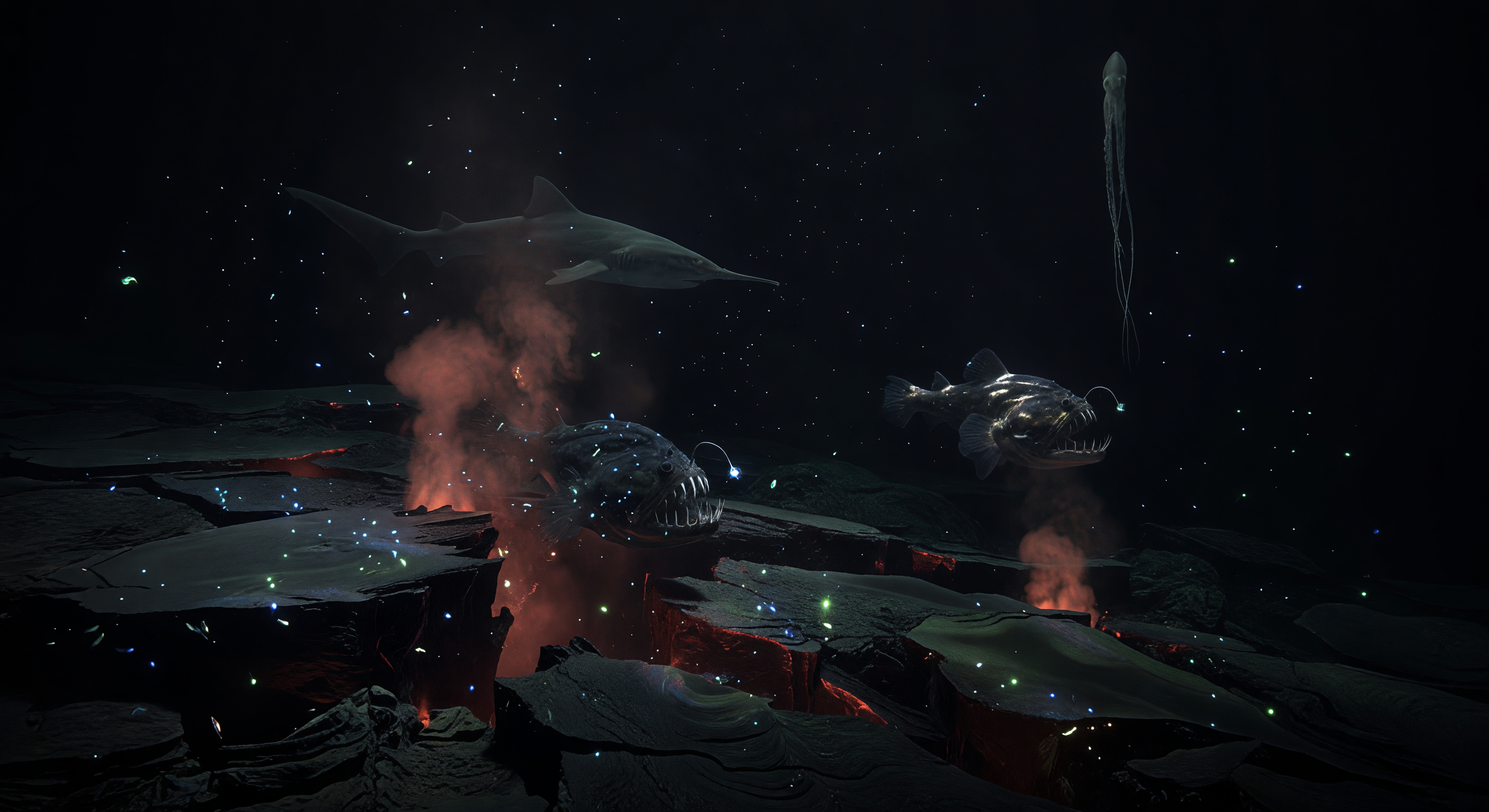
Along a mid-ocean ridge fracture somewhere between one and four kilometers beneath the surface, freshly emplaced basalt bleeds dim red-orange heat through its cracked glassy crust, the only thermal light in an otherwise lightless world, while hydrothermal plumes rise in soft chemiluminescent veils through near-freezing water pressing down at hundreds of atmospheres. An anglerfish moves with glacial patience past fractured lava ledges, its bioluminescent lure pulsing blue-white ahead of a gape of translucent recurved teeth, while bioluminescent plankton brushed aside by its passage flicker briefly cyan and green against its flanks — a momentary betrayal of motion in a world that rewards stillness. Deeper in the composition, a viperfish hangs in near-perfect suspension, its needle fangs and dark metallic skin catching the faint microbial sheen rising from mineralized surfaces, and farther back in the column the Magnapinna squid trails its impossibly elongated arm filaments downward like pale ribbons dissolving into black. This is a world of patchy food and lethal patience, where evolution has refined stealth, sensory amplification, and bioluminescent deception across millions of years of unwitnessed darkness — a predator guild shaped entirely by pressure, cold, and the utter absence of light that did not first arise within a living body.
Other languages
- Français: Lueur du Basalte Volcanique
- Español: Brillo de Basalto Nuevo
- Português: Brilho do Basalto Fresco
- Deutsch: Frisches Basalt Rücken Glühen
- العربية: توهج حافة البازلت
- हिन्दी: नया बेसाल्ट चमक
- 日本語: 新鮮な玄武岩の輝き
- 한국어: 신선한 현무암 능선 빛
- Italiano: Bagliore del Basalto Fresco
- Nederlands: Vers Basalt Richel Gloed