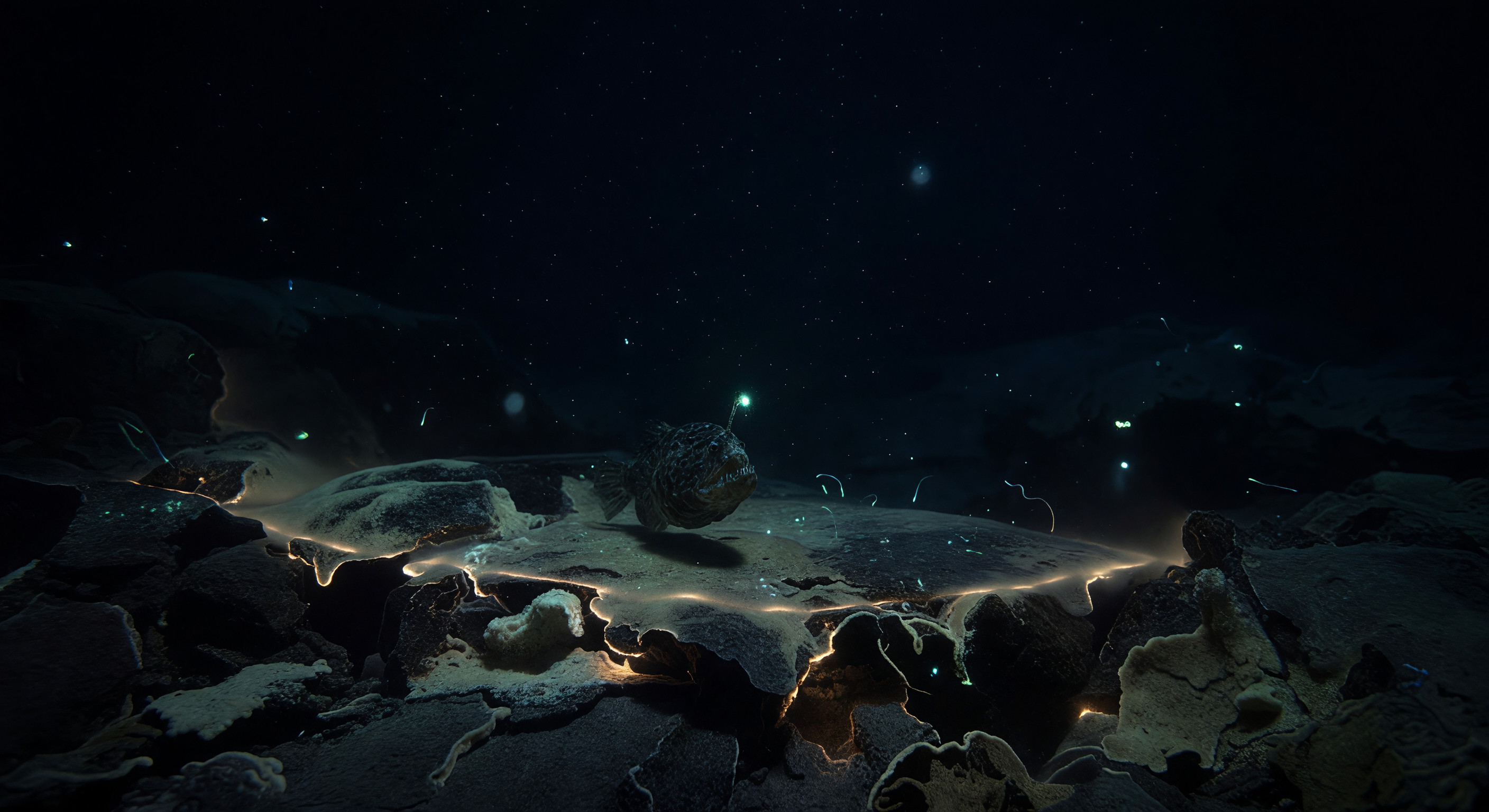
At the edge of a diffuse hydrothermal seep along a mid-ocean ridge, where mineral-laden warm water bleeds upward through fractured basalt at roughly 200 to 300 atmospheres of pressure, a small anglerfish holds its ambush position with absolute stillness in water near 2 °C. Its esca — the bioluminescent lure evolved through millions of years of selection in perpetual darkness — casts the only concentrated light in the scene, a blue-green point generated by symbiotic bacteria housed in specialized tissue, while sparse chemiluminescent pulses from vent-associated fauna and microbial mats add faint cyan halos across sulfur-pale mineral crusts and glassy basalt. Marine snow, the slow rain of organic particulates descending from the sunlit ocean more than a kilometer above, drifts freely through the water column, each flake a fragment of the biological pump connecting this lightless world to the surface biosphere. The thermal boundary where warm vent effluent meets near-freezing deep seawater creates a refractive shimmer — a chemocline visible in the slight distortion of background dark — concentrating prey drawn to elevated nutrients and microbial productivity at this narrow, predator-rich margin. Here, without witness, without season, the ocean's oldest predatory logic plays out in cold silence: patience, a single glowing lure, jaws barely parted, and the crushing dark pressing in from every side.
Other languages
- Français: Embuscade aux évents diffus
- Español: Emboscada en ventisquero difuso
- Português: Emboscada na Fenda Difusa
- Deutsch: Hinterhalt am Diffusauslass
- العربية: كمين الفوهة المنتشرة
- हिन्दी: विसरित वेंट घात
- 日本語: 拡散噴出口の待ち伏せ
- 한국어: 분산 분출구 매복
- Italiano: Agguato al Vento Diffuso
- Nederlands: Hinderlaag bij Diffuse Vent