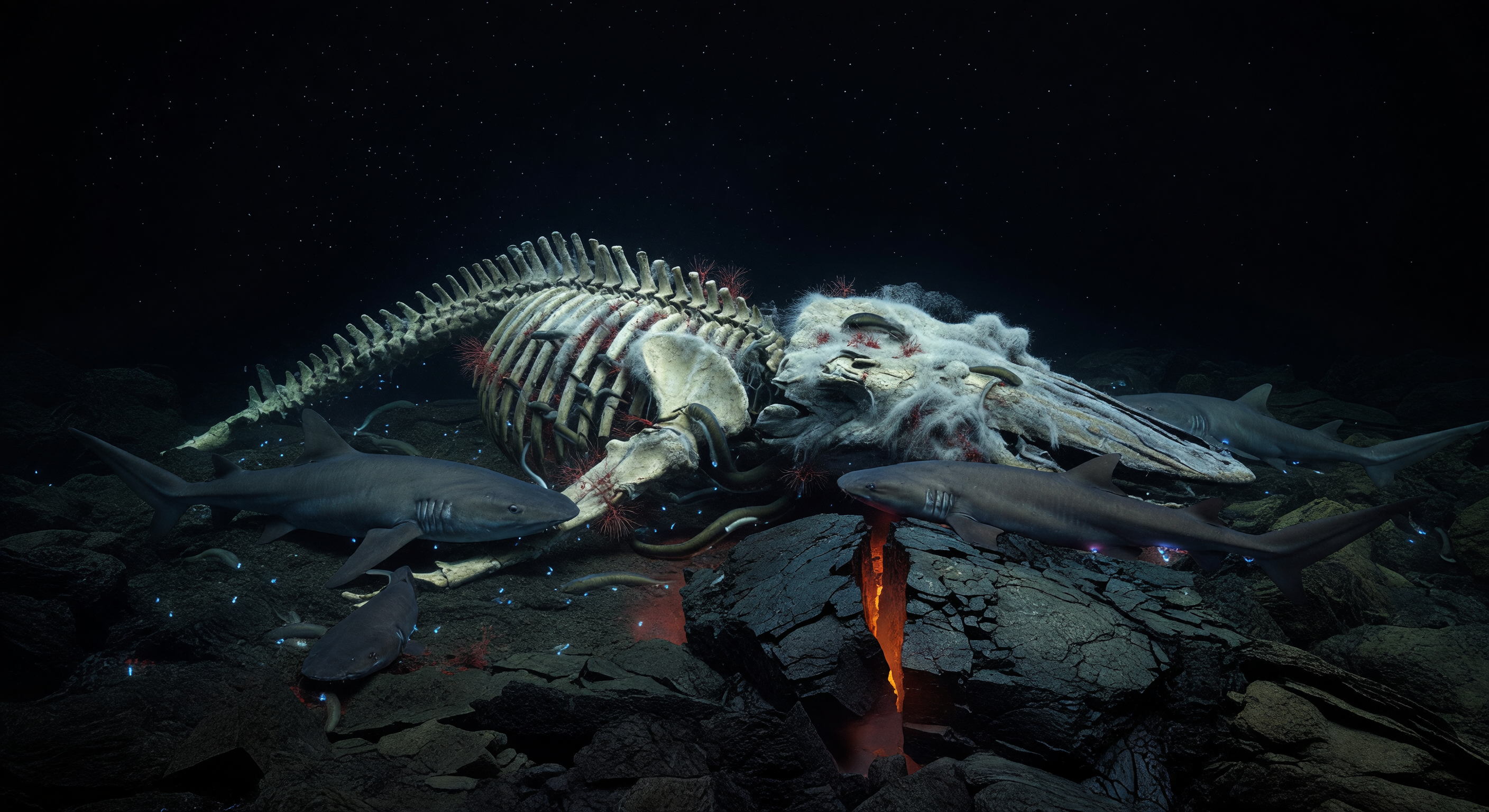
At depths where crushing pressure silences all but the chemistry of decay, a sperm whale's skeleton lies across a newly fractured basalt ridge, one of the few places on Earth where tectonic heat and biological richness converge without design. The fresh lava fracture still breathes a dull orange glow through its glazed black crust, casting mineral-dusted marine snow into faint relief as particles drift past razor-edged rock cooled seconds or centuries ago — time rendered visible in texture alone. Every exposed bone surface is colonized: vertebrae disappear beneath snow-white bacterial mats fed by sulfide rising from lipid-soaked sediment, Osedax worms bore silently into cortical bone while their feathery red plumes pulse with each chemical exchange, and hagfish twist through the orbital cavities and between collapsed ribs in slow, purposeful knots. Sleeper sharks — broad, unhurried, ancient in their patience — circle the periphery, occasionally pressing their blunt snouts into softened cartilage, their fin edges briefly outlined by the cold cyan sparks of bioluminescent organisms disturbed in the water column above. This carcass is not a site of death but of extraordinary productivity, a chemosynthetic oasis producing more biological complexity per square meter than almost any surrounding seafloor, its sulfide chemistry mirroring the metabolic logic of hydrothermal vents while the fresh magmatic heat beneath the basalt adds a geological pulse that no whale fall beside cold abyssal sediment ever possesses.
Other languages
- Français: Veines de Basalte Incandescent
- Español: Venas de Basalto Ardiente
- Português: Veias de Basalto Quente
- Deutsch: Frische Basalt Hitzadern
- العربية: عروق البازلت المتوهجة
- हिन्दी: ताज़ा बेसाल्ट ऊष्मा नसें
- 日本語: 新鮮な玄武岩の熱脈
- 한국어: 신선한 현무암 열맥
- Italiano: Vene di Basalto Ardente
- Nederlands: Verse Basalt Heetaders