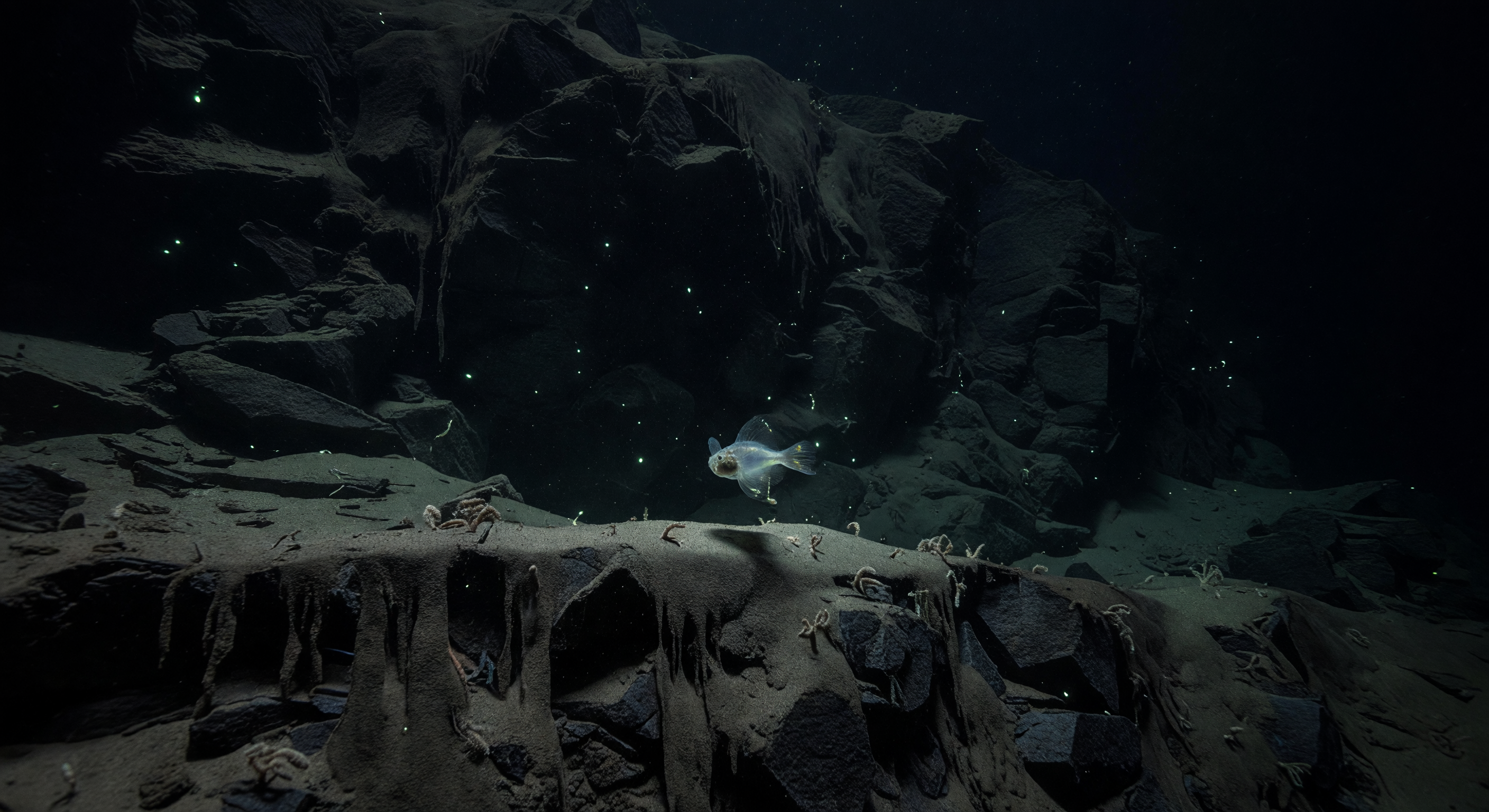
At around 7,500 to 8,500 metres depth on the steep flank of a major oceanic trench, pressures approaching 85 megapascals compress every molecule of water into a medium that no sunlight has ever reached, a permanently aphotic world where the only visible light emerges from life itself. Here, a lone hadal snailfish — likely a species of *Pseudoliparis* or a closely related liparid — hovers with effortless poise just above a narrow sediment bench cut into a plunging wall of fractured basalt and draped ravine mud, its gelatinous, translucent body an evolutionary answer to crushing pressure: reduced mineralisation, piezolyte-rich tissues, and a skeleton so delicate it would collapse at surface conditions. Sparse agglutinated xenophyophores — giant single-celled foraminifera that are among the largest individual cells on Earth — dot the pale silt of the bench, filter-feeding particles delivered by topographically steered currents and the slow rain of marine snow that drifts through the near-freezing water at roughly 1 to 2 degrees Celsius. Occasional cold cyan-green pulses of bioluminescence from drifting planktonic organisms sketch the cliff face behind the fish in brief, living light, catching the translucent margins of its broad pectoral fins before dissolving back into absolute darkness. This world is not waiting to be discovered; it has existed on its own terms, in perfect pressurised silence, for millions of years.
Sirena Deep