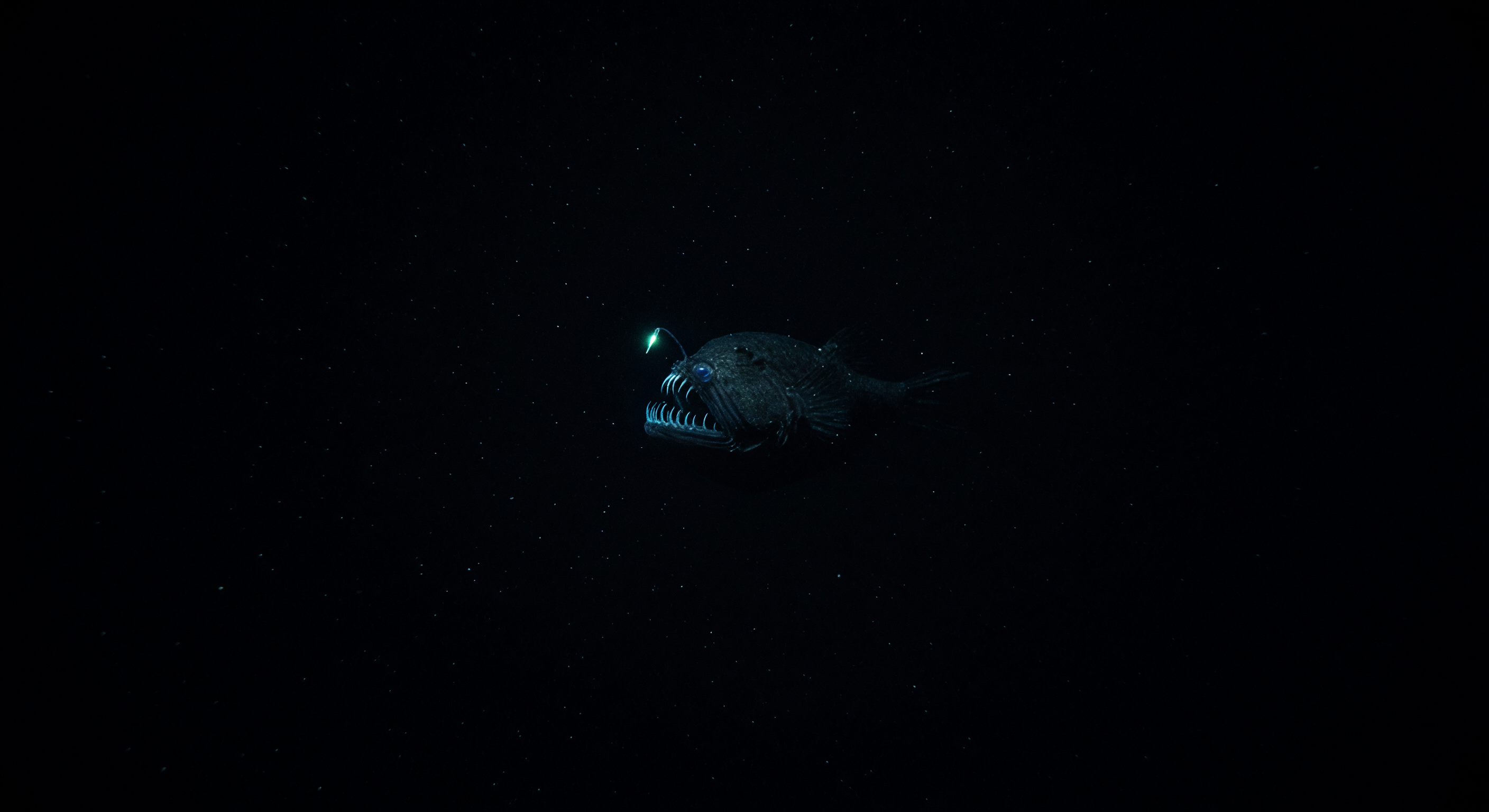
In the absolute darkness between one and three kilometers down, where pressure exceeds two hundred atmospheres and cold hovers near two degrees Celsius, a female abyssal anglerfish — likely *Melanocetus* or a close relative — holds herself suspended in open midwater with barely a flicker of her caudal fin, her entire metabolic existence calibrated for patience and minimal energy expenditure. The only light in this volume of ocean is her own: the esca, a modified dorsal spine tipped with a symbiotic colony of bioluminescent bacteria, pulses with a steady blue-green glow that is simultaneously a fishing lure, a private language, and a weapon — drawing prey organisms upward through the marine snow, their small bodies betrayed by the very curiosity that evolution built into them. Each drifting particle of marine snow — fragmented fecal pellets, shed mucus, dead zooplankton descending from the sunlit world far above — passes briefly through that living light, then vanishes back into blackness, a quiet rain that constitutes much of the energy budget for this entire zone. Her recurved teeth, translucent as glass and needle-thin, are evolved not to cut but to cage: anything that enters that crescent jaw will find no mechanical escape, the recurved geometry ensuring closure is irreversible. Here the ocean exists in a state that preceded the first eye and will persist long after the last one closes — pressurized, lightless except for its own cold fire, and entirely indifferent to being known.
Bathypelagic predators